Research Notes: The Search for Jarred Branson’s Family
Download a PDF Copy of This Research Narrative
This study uses the Friends, Associates, and Neighbors (FAN) research method, which looks beyond an individual ancestor to the families and associates who repeatedly lived, migrated, worshiped, witnessed records, conducted business, and intermarried with that ancestor and his family.
These associations should also be viewed in the context of eighteenth-century migration. Many of the families in this study were moving into newly settled areas where ministers, relatives, neighbors, and associates helped establish new churches and Friends meetings. Religious affiliation was important, but migration networks could also include people who did not belong to the same denomination.
The parentage of Jarred Branson remains unproved. My purpose here is not to assign him to a particular set of parents, but to examine the Branson relatives, neighbors, religious associates, migration companions, and genetic evidence surrounding him. Taken together, the evidence increasingly suggests that Jarred belonged to, or was closely connected with, the extended Crooked Run Branson network, although the precise relationship has not yet been established.
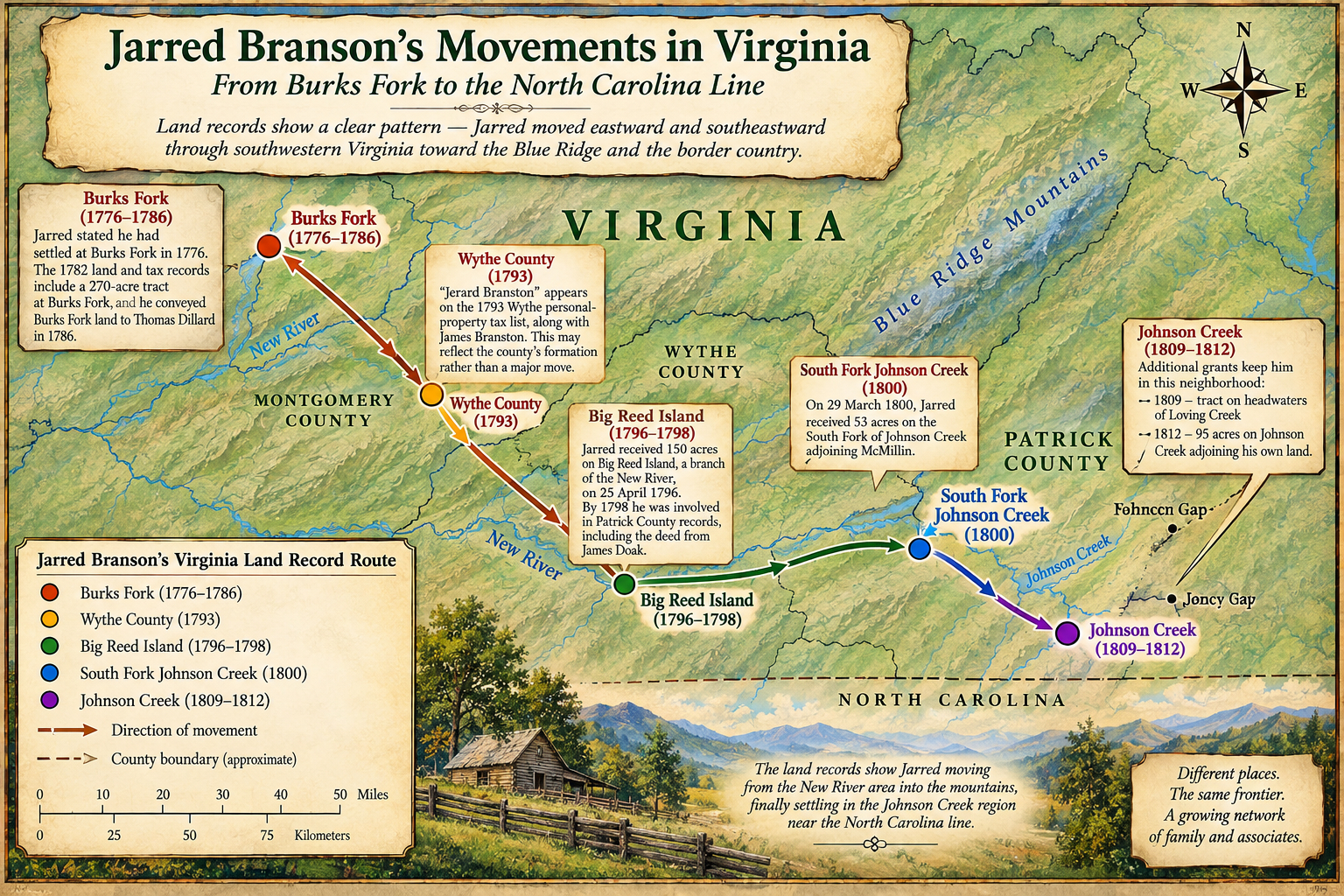
Jarred Branson’s Movements in Virginia
John Day Branson and the Crooked Run Family
John Day Branson (1704-1770), son of Thomas Branson Sr. and Elizabeth Day, became an important landholder in the Crooked Run area of Frederick County, Virginia. His son Thomas Branson married Jane Painter, whose family also belonged to the Crooked Run community. John Day Branson remained associated with Crooked Run through the end of his life. His will was written in 1769 and proved in Frederick County on 6 November 1770.
The will is important because it names a grandson John Branson who was to receive part of the home plantation after the death of John Day Branson's widow. The identity of this grandson remains unresolved. A traditional reconstruction identifies Thomas and Jane Painter Branson's son John, born 26 May 1764, as a possible candidate, but the evidence does not yet prove that the grandson named in the will was this child.
Thomas Branson, Jane Painter, and the Move Southwest
Thomas Branson and Jane Painter remained committed Quakers. Their movements can be followed through Friends' records, and their associates included the Quaker minister Thomas Beals. Thomas also held a position of responsibility among Friends: on 4 October 1788 Crooked Run Preparative Meeting reported his request to be released from serving as an overseer.
Thomas had already acquired land much farther southwest. On 3 April 1775 he received 123 acres in Wright's Valley on Bluestone, then in Fincastle County. On the same date John Corder, husband of Thomas's sister Elizabeth Branson Corder, received adjoining Bluestone land. Jarred later stated that he settled on Burks Fork in 1776. Thus, members of the John Day Branson family and Jarred were moving into the same broad southwestern Virginia region at nearly the same time.
Another potentially important step appears in Fauquier County. In 1773, a Thomas Branson and a John Branson were recorded there with John Painter, Bethany Haines, and others linked to John Day Branson. The John in this record could not have been John Day Branson, who had died in 1770. The identities of the 1773 Thomas and John have not been conclusively established, but John Painter's presence makes the record particularly interesting. Earlier land records also place Branson, Painter, Haines, and Oglesby together in the Crooked Run area. If the 1773 Thomas was Jane Painter's husband, the Fauquier record may represent another point in the movement of this family and its associates toward southwestern Virginia.
By 1782 both Thomas Branson and Jarred Branson appear in Montgomery County personal property tax records. Their presence in the same county is significant, but it does not establish that Thomas was Jarred's father or sibling. It is better understood as evidence that Jarred was living within the same broad migration region occupied by a documented Crooked Run Branson family.
Jarred's Religious Path
Jarred's adult life did not follow the same religious pattern as that of Thomas and Jane. He married outside the Society of Friends and settled in a part of the county that, at the time of his arrival, did not yet contain the substantial Quaker population that developed there later. No record presently known shows Jarred participating in a Friends meeting or moving by Quaker certificate.
This difference should not be used to exclude him from the extended family. Religious divergence already existed among the Bransons. Members and descendants of John Day Branson's family became associated with the Baptist faith rather than remaining Friends, while Thomas and Jane continued as committed Quakers. If Jarred belonged to this larger family, he appears simply to have followed a different religious and social course as an adult.
Jarred and the Revolutionary Political Divide
Jarred was of an age when Revolutionary military service might ordinarily be expected, yet no record of such service has been found for him. Virginia Quakers could be exempted from personal militia service because their religious principles opposed bearing arms, but Jarred himself is not presently known to have claimed a Quaker exemption or to have remained a practicing Friend.
There is also reason to examine possible Loyalist influence in Jarred's immediate circle. His father-in-law, John Cock, was Jarred's neighbor on Burks Fork and belonged to the close family network in which Jarred lived. John Cock and Aaron Collier were identified with the Tory or Loyalist side. Jarred later provided information concerning Loyalists in Montgomery County, including men within this close family and community circle.
The circumstances under which Jarred provided that information are unknown. Because John Cock was his own father-in-law, the statement should not automatically be interpreted as evidence that Jarred was a Patriot who voluntarily reported Loyalists. It is possible that he knew of their activities because he moved within the same circle; it is also possible that he cooperated with Patriot authorities for reasons that are no longer documented. No record presently found establishes Jarred's own allegiance. Possible Loyalist sympathy therefore remains a working hypothesis, not a proved fact.
James Branson and the Y-DNA Evidence
Another Branson family may be especially important to understanding Jarred. James Branson and his wife, believed to have been Mary Caile, can be traced from northern Virginia southward. James appears in Loudoun County tax records and later in Fairfax Monthly Meeting records, where his family and children were recorded. Benjamin Branson and his family were recorded at about the same time. Benjamin is thought to have been a son of Joseph Branson, making James's appearance with him worth further study, although it does not establish James's parentage.
James and his family later appear in Pittsylvania County and eventually in Wythe County. This movement places another Branson line in the same broader southwestern Virginia region in which Jarred lived. Mary is believed to have been the Mary Branson named in the 1786 will of David Caile/Keel, but that will does not identify Mary's husband, so her identification as James's wife remains a working hypothesis.
The genetic evidence makes James particularly important. Y-DNA from a documented male-line descendant of Jarred matches Y-DNA from descendants believed to descend from James. If the descent from James is correctly documented, the result strongly suggests that the Jarred and James lines share a paternal ancestor. It does not establish James's father or Jarred's exact place in the Branson family.
The larger Y-DNA picture is complicated. Documented male-line descendants of Jarred belong to an I-M223 paternal line, while descendants attributed to other branches of the family of Thomas Branson Sr. and Elizabeth Day have produced conflicting Y-DNA results. Those results cannot all represent the biological Y-DNA of the same paternal ancestor. Somewhere within one or more of the pedigrees there must have been a break in the expected father-to-son line, whether through an incorrect traditional pedigree, adoption or informal parentage, undocumented biological paternity, or another circumstance. At present there is not enough evidence to determine where that break occurred.
A later connection involving James's probable descendants further complicates his placement. John A. Branson, who married Sarah Surratt in Patrick County, was likely a son of John Allen Branson, who was recorded as a son of James Branson. Sarah Surratt's brother Wiley married Hannah Coltrane, whose mother, Elizabeth Branson, was a daughter of Levi Branson and Mary Maynor. This places a probable descendant of James within the extended family circle of Levi Branson, a son of Thomas Branson Jr. and Rebecca Borden. James's association with Benjamin Branson keeps a relationship with Joseph's branch worth considering, while the later Surratt-Coltrane connection points toward Levi's branch as well. His precise place in the family should therefore remain unresolved.
Abraham McMillan and the Patrick County Network
Another recurring associate was Abraham McMillan. In 1782 he appears in Montgomery County, Virginia, where Jarred Branson, Thomas Branson, and Thomas Beals were also recorded. He later lived in Surry County, North Carolina, in a neighborhood that included Bowater Beals and his wife Lois Branson, daughter of Thomas Branson and Jane Painter, as well as numerous practicing Quaker families. Abraham subsequently moved back north to Patrick County, Virginia, just across the border from Surry, where his family became closely associated with Jarred Branson's family and the Dillards. In the Surry record, McMillan was listed only four lines away from Lois Branson Beals.
The McMillans themselves were not Quakers, so their repeated appearance cannot simply be explained by membership in the Society of Friends. Their movements fit a broader migration and associate network in which relatives, neighbors, religious families, and other associates moved into newly settled areas together or in overlapping stages.
Abraham's wife appears to have been Elizabeth 'Betty' LaPrade, from a family with earlier roots in Chesterfield County, Virginia. The LaPrades were associated with the Bernard family, while Allen Bernard was a close friend of Larkin Branson, son of Baptist Elder John Branson. A Peter LaPrade later owned a small tract in Patrick County associated geographically with Thomas Dillard. Peter's precise relationship to Betty has not been established. The LaPrade evidence therefore does not establish a relationship between Jarred and Larkin Branson, but it adds another possible connection between the older Chesterfield network and the later McMillan-Dillard-Branson network in Patrick County.
Geographic Context: Crooked Run to the Virginia-North Carolina Border
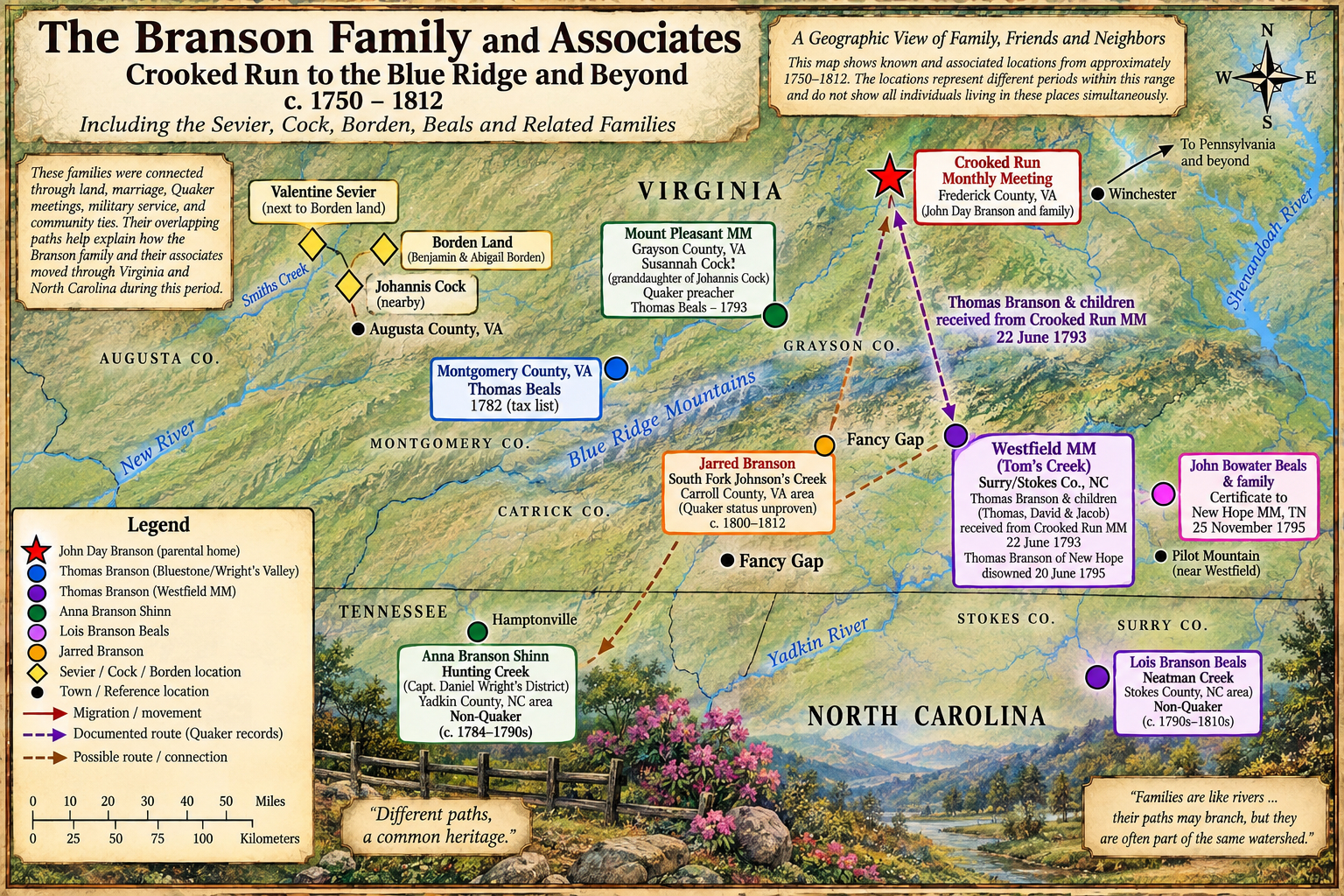
The geographic distribution of John Day Branson's children provides important context. His plantation lay on Crooked Run in Frederick County, approximately fifteen miles south of Winchester, but several of his adult children established homes much farther south and southwest. Thomas settled in the Bluestone Creek region of Virginia. Anna Branson Shinn was living in old Surry County, North Carolina, in Captain Daniel Wright's District, in the general Hunting Creek/Hamptonville area. Lois Branson Beals was associated with the Neatman Creek area of old Surry County, now Stokes County, near present-day Germanton.
Jarred's documented movements occurred within this same broader Virginia-North Carolina backcountry. He appears first in the Burks Fork/New River region, later on Big Reed Island Creek, and by 1800 held land on the South Fork of Johnson Creek in Patrick County, near the present-day Fancy Gap borderland. His Johnson Creek land adjoined McMillion/McMillan, and later land records show his continued presence in that creek system.
It has sometimes been suggested that Jarred was unlikely to have been related to Thomas Branson because the two lived approximately fifty miles apart during part of their lives. The settlement pattern of John Day Branson's documented children demonstrates why that distance cannot by itself be persuasive evidence against kinship. Members of the same family established households separated by substantially greater distances. Likewise, Jarred's lack of a known Quaker record does not by itself exclude a relationship, because Thomas retained a Quaker affiliation while other members of the extended family followed different religious paths.
Thomas Beals, Westfield, Mount Pleasant, and the Captive John Branson
The Beals connection provides another link between the Crooked Run Bransons and southwestern Virginia. Family histories concerning Rev. Thomas Beals describe his move to the Bluestone region in 1781. A later family account describes an Indian attack in which James Horton and a young John Branson were captured. The exact year is inconsistent in later retellings, so neither 1781 nor 1782 should be treated as firmly established from the material presently in hand.
I believe the captive was probably John Branson, born 26 May 1764, son of Thomas Branson and Jane Painter, although no contemporary record yet found explicitly identifies him as their son. The traditional account says that Branson remained a prisoner for about three years before escaping and returning home in poor health. Because the capture date is uncertain, the return date should also remain approximate. The chronology is nevertheless noteworthy because Thomas and Jane were received at Crooked Run in 1784 on a certificate from New Garden Monthly Meeting, while John was not among the children named with them.
A Northern Neck land grant issued on 2 April 1788 is in the name of John Branson for 382 acres on both sides of Little Run, a drain of Crooked Run, adjoining his own land, John Painter Jr., and William Evans. The original survey notes show that the grant originated with a warrant dated 26 May 1766 and a survey for 'Mr. John Branson of Frederick County' on 26 November 1766, witnessed by Thomas Branson and Isaac Painter. John Day Branson was still living in 1766 and may have been the man for whom the survey was made. Because he died in 1770, the 1788 issuance raises the possibility that an heir or successor later completed the grant. His 1769 will's reference to 'my grandson John Branson' makes the younger generation especially interesting, but no record yet found establishes the legal transfer or identifies the 1788 John with certainty.
Thomas and Jane later left Crooked Run. On 5 November 1791 they requested a certificate to Westfield Monthly Meeting in North Carolina for themselves and five children: Thomas, David, Eunice, Jacob, and Elizabeth. John was not included. Westfield minutes record that on 22 June 1793 Thomas Branson and his sons Thomas, David, and Jacob were received on certificate from Crooked Run. On 25 November 1795 John Bowater Beals and his family were granted a certificate to New Hope Monthly Meeting in Tennessee.
A related cluster appears north of the Virginia line. Thomas Beals was recorded in Montgomery County in 1782 in a tax list that also included James Horton, Jarred Branson, Thomas Jessup, and other families of interest. By 1793 Thomas Beals was associated with Mount Pleasant in Grayson County. Susannah Cock, a granddaughter of Johannis Cock, was also associated with the Mount Pleasant Quaker community and served as a Quaker preacher. Jarred's wife Sarah Cock belonged to this extended Cock family. These records do not prove Jarred's parentage, but they document Crooked Run Bransons and interconnected Beals and Cock families moving through the same Virginia-North Carolina border region during the years surrounding Jarred's residence there.
The Haines, McKay, Jobe, Cock, and Pate Connections
The Haines family provides one of the strongest continuing links between the Crooked Run Bransons and Jarred's later family. Bethanah Haines acquired Crooked Run land through a chain originating with Thomas Branson Jr., and Haines family members repeatedly appear with Bransons in roads, militia, Quaker, and neighborhood records. Robert Haines, Bethanah's son, was a Quaker minister in the same religious community as John Day Branson. The association continued after migration: Jarred's daughter Mary Ann Branson married Luster Haines in Patrick County in 1811.
The McKay family was also closely connected with John Day Branson. Robert McKay Jr. was a land neighbor and witness in Branson transactions, and Andrew McKay witnessed and proved John Day Branson's will. The McKays were interwoven with the Jobe family. Robert McKay Jr.'s granddaughter Deborah McKay married Jacob Jobe, and their daughter Mary Leah Jobe married into the Cock family. According to the Y-DNA evidence in my research, the Cock family into which Mary Leah married was related through the paternal line to John Cock, Jarred's father-in-law. This does not establish Jarred's ancestry, but it provides another bridge between the earlier Crooked Run associate network and the Cock family surrounding Jarred.
Another geographic link appears through Jeremiah Pate. A later Bluestone record places Pate in Wright's Valley adjoining the claim of William Brown, whose 1784 Bluestone entry included 'Branson's improvements.' Pate later had a Montgomery County land dealing with Andrew Cock, Jarred's brother-in-law. The sequence - Branson improvements at Bluestone, the Brown claim, Jeremiah Pate, and Pate's later association with Andrew Cock - is circumstantial, but it is another example of the same people and places recurring around Jarred and the Crooked Run migration network.
Benjamin Borden, Valentine Sevier, and John Cock
Another potentially significant connection appears at Smith's Creek in the Shenandoah Valley. Surveys there place Valentine Sevier and Johannis/John Cock near land associated with Benjamin Borden. Benjamin Borden was the father of Rebecca Borden, wife of Thomas Branson Jr., while John Cock was the father of Sarah Cock, who married Jarred Branson. Valentine Sevier was also closely connected to the Cock family and was John Cock's brother-in-law.
The Smith's Creek evidence should be interpreted cautiously. Nearby land does not necessarily indicate friendship, kinship, or cooperation. Borden and Sevier were extensively involved in land transactions and may have been associates, competitors, or simply participants in the same developing land market. What the records do establish is that the Borden, Sevier, and Cock families occupied overlapping geographic and land networks before members of these families and their associates appeared farther southwest.
The geographic overlap apparently continued. A 1750 reference places Sevier with the Harmans in a substantial land interest on both sides of Bluestone Creek. Approximately twenty-five years later, Thomas Branson, son of John Day Branson, had his 123-acre Wright's Valley survey on Bluestone, with his brother-in-law John Corder receiving adjoining land the same day. Smith's Creek alone might be coincidence; the later Bluestone intersection makes the recurrence more noteworthy. It still does not prove that Sevier caused or participated in the Bransons' migration, but it shows that some of the same family and land networks surrounding the Bransons and Cocks can be traced across more than one stage of movement toward southwestern Virginia.
What the Evidence Suggests
None of these connections proves Jarred's parentage. The evidence is strongest for a broader conclusion: Jarred was probably connected to the extended family and migration network of the Crooked Run Bransons. The same surnames and family networks recur from Crooked Run to Bluestone, Montgomery County, Burks Fork, Surry County, and later Patrick County communities: Branson, Painter, Haines, McKay, Jobe, Cock/Cox, Corder, Beals, McMillan, Dillard, LaPrade, and Pate.
The documentary and geographic evidence places Jarred within overlapping migration and associate networks already connected with known Branson families. The Y-DNA evidence adds a different and potentially stronger dimension by linking Jarred's documented paternal line to descendants believed to descend from James Branson. Yet the conflicting Y-DNA results among other proposed Branson branches prevent the genetic evidence from identifying Jarred's exact place in the family at present.
Religious and political evidence should remain secondary to those documentary and genetic questions. Jarred did not live as a devout Quaker in the manner of Thomas and Jane, but religious divergence occurred elsewhere in the extended family. His lack of known Revolutionary military service and his close family association with Loyalists, particularly his father-in-law John Cock, make Loyalist sympathy a reasonable possibility, but Jarred's political allegiance remains unproved.
At present I regard several questions as unresolved: the identity of the grandson John named in John Day Branson's 1769 will; whether John Day Branson was the John for whom the 1766 Little Run survey was made; whether a younger John later succeeded to an interest in that tract; the precise relationship of James Branson to the older Branson family; Jarred's exact relationship to the Crooked Run Bransons; and Jarred's own political allegiance during the Revolution. These uncertainties should remain clearly distinguished from the documented relationships and records described above.
The next stage of research should therefore concentrate less on assigning Jarred to a parent and more on resolving the paternal-line problem: documenting the James Branson Y-DNA line as completely as possible, identifying the competing Branson Y-DNA pedigrees, and continuing to search the land, court, tax, Quaker, and Revolutionary-era records for evidence connecting Jarred or James to a specific branch of the Crooked Run family.